
Understanding cricket bat weights is essential for players of all levels. Nothing is worse than paying money for a bat that is too heavy or too light; you are looking for the Goldilocks weight.
(However, if you have spent money on a new bat and it's too heavy, at Trogon, we offer a cricket bat weight reduction service.)
The weight of a bat can significantly impact a player's performance, influencing factors such as balance, stroke play, and overall comfort at the crease. This is the same whether you are using an adult or junior cricket bat.
What are the different cricket bat weights?
Cricket bat weights vary to suit different playing styles. Lightweight bats (2.4-2.6 lbs) offer agility for technical players. Medium-weight bats (2.6-2.9 lbs) balance power and control, ideal for versatile players. Heavyweight bats (2.9-3.1 lbs) provide maximum power for aggressive hitters.
Now, let's examine this blog post in more detail and learn all the facts about cricket bat weights.
Cricket Bat Weight Introduction - Ideal Weight Of The Cricket Bat
The ideal weight of a cricket bat varies depending on the player's strength, height, and playing style.
Generally, adult bats range from 2lbs 4oz to 3lbs 1oz, while junior bats are lighter.
Choosing a bat that feels comfortable and allows for agile movements is vital.
Does the Weight Of The Cricket Bat Matter?
Yes, the weight of the cricket bat matters immensely. A bat that's too heavy can hinder a player's timing and stroke play, while one that's too light may not provide enough power.
The key is finding a balance that complements the player's technique.
Weight of the Cricket Bat and Playing Style
The weight of a cricket bat plays a pivotal role in a player's performance and is closely linked to their playing style. Different weight ranges offer various advantages and disadvantages.
Let's explore each weight range's pros and cons to better understand how they align with different playing styles.
Lightweight Bats (2lbs 4oz to 2lbs 6oz)
Pros:
- Manoeuvrability: Lightweight bats are easier to handle, allowing quick adjustments and better wrist movement. This is crucial for playing cross-batted shots or reacting to fast bowling.
- Better for Technical Players: These bats favour players with a technical approach who rely on timing and precision rather than raw power.
- Reduced Physical Strain: They are less taxing on the player's arms and shoulders, reducing fatigue over long innings.
Cons:
- Less Power: Lightweight bats might not provide the same level of power as heavier bats. Players may find it challenging to hit the ball as far, particularly when playing lofted shots, or they don't believe they can reach the boundary, which then plays on their mind.
- Can be Overpowered: In situations where the ball is coming onto the bat with considerable pace, a lightweight bat might not offer enough mass to counteract the force effectively, although this can be overcome with good timing.
Medium Weight Bats (2lbs 6oz to 2lbs 9oz)
Pros:
- Balanced Performance: Medium-weight bats strike a perfect balance between power and control, making them suitable for various playing styles.
- Versatility: These bats can adapt to different pitch conditions and match situations effectively.
- Stability in Shots: They provide a stable base for hitting the ball, which can benefit both defensive and offensive shots.
Cons:
- May Not Suit Extreme Styles: While they are versatile, medium-weight bats might not fully suit players at the extremes of the playing style spectrum (either very aggressive or highly technical).
- Average Power and Speed: They offer moderate power and speed, but might not excel in either area as compared to lightweight or heavyweight bats.
Heavyweight Bats (2lbs 9oz to 3lbs 1oz)
Pros:
- Maximum Power: Heavyweight bats are ideal for players who focus on power-hitting. The additional mass behind the ball can lead to more forceful shots.
- Effective for Hard Hitters: They suit players with a strong physical build and good technique who can handle the extra weight without compromising on bat speed.
Cons:
- Reduced Manoeuvrability: The heavier weight can make the bat less agile, potentially impacting the player's ability to play quick-reaction shots.
- Increased Physical Demand: They require more strength to wield effectively, which can lead to quicker fatigue, particularly in longer formats of the game.
- Potential for Technique Compromise: Players not accustomed to the weight might alter their natural playing style, negatively affecting their overall performance.
Does a Heavier Bat Always Hit Farther?
Many players assume that a heavier bat automatically leads to longer shots, but this isn’t always true. While more mass can generate more force, the real key to power is maintaining bat speed, balance and control. If a bat is too heavy and slows your swing, the ball will not travel as far.
Bat Speed vs Mass
Power comes from a combination of good technique, timing, and the speed at which you bring the bat down. A bat that feels comfortable and allows you to swing freely will almost always produce better results than a bat that feels too heavy.
When a Heavier Bat Helps
A heavier bat does offer more punch if you can still swing it quickly. Strong, aggressive players often benefit from this added mass. For others, a medium-weight bat delivers better overall performance.
Does Pickup Matter More Than Weight?
One of the most misunderstood aspects of cricket bats is the difference between scale weight and pickup. Pickup refers to how the bat feels when you pick it up and move it through your swing and in your stance.
Two bats with the same weight can feel totally different depending on:
- the distribution of mass
- handle type
- shape of the spine
- amount of wood in the shoulders and toe
Why Pickup Matters More
Your ability to move the bat quickly, adjust to different types of bowling, and maintain natural timing all link directly to pickup, not the number on the scale.
A bat with excellent pickup can feel 2–3oz lighter than it actually is.
What Trogon Does to Improve Pickup
When making bats, I constantly adjust:
- the spine
- Making sure the middle isn't too close to the toe
- the curvature of the face
- the pressing
Pickup is the true test of a bat, weight is only part of the story.
What Bat Weights Do Professional Players Use?
One of the most common questions players ask is: “What weight do the pros use?”
Interestingly, most professional players use bats in the medium-weight category.
Typical Professional Weights
- Many top-order players use bats between 2lb 8oz and 2lb 10oz.
- Aggressive players sometimes go slightly heavier, up to 2lb 11oz – 2lb 12oz.
- Very few modern players use bats above 3lb because the modern game demands fast hands, quick wrists, and rapid bat speed
What Matters to the Pros
Professionals select bats based on:
- pickup
- bat speed
- shot control
- stroke-making style
…not just weight.
This is why many of their bats weigh more than they feel.
How Heavy Is Virat Kohli’s Bat?
Virat Kohli is often used as a benchmark for guidance on weight. Kohli typically uses a bat around 1.1kg (2lb 9oz), which sits at the top end of the medium-weight range.
Despite this weight, his bat feels extremely balanced because of expert shaping, a well-positioned spine, and a distribution that prioritises pickup.
Why This Matters for Club Players
Kohli’s bat works for him because of:
- elite technique
- strong wrists
- years of professional conditioning
For most players, a medium-weight bat between 2lb 7oz and 2lb 9oz offers the best blend of power and control.
What Is the Best Cricket Bat Weight for Beginners?
For beginners, especially juniors or adults new to cricket, the most important factor is control and the ability to play correct shots.
Why Beginners Should Avoid Heavy Bats
A heavy bat:
- slows down hand speed
- encourages poor technique
- reduces confidence
- affects timing
- can cause injury
Recommended Beginner Weights
- Juniors: follow the size chart (lighter is usually better)
-
Adults: aim for 2lb 7oz – 2lb 9oz
These weights support good technique, quick reactions, and better skill development.
Is a Lighter Bat Better for Timing?
Yes, for many players, a lighter bat improves timing. Timing relies on:
- bat speed
- control
- the ability to adjust late
- reacting to an unexpected bounce or swing
Why Timing Improves With Lighter Bats
A lighter bat lets you:
- play late
- use your wrists
- adjust mid-swing
- place the ball into the gaps
This is especially helpful when facing quicker bowlers.
What Weight Is Best for T20 Power Hitting?
In T20 cricket, bat speed is everything. Even the most aggressive players rarely use extremely heavy bats.
Recommended T20 Weights
Most T20 batters use medium to medium-heavy bats:
-
2lb 8oz – 2lb 10oz
These weights deliver: - fast bat speed
- strong power
- excellent pickup
A 3lb bat slows swing speed too much for modern T20 cricket.
Trogon's Guide To Selecting the Right Weight Of The Cricket Bat
Selecting the right weight for a cricket bat is crucial for optimising performance.
Here's a detailed guide to help you choose the perfect weight based on your playing style and physical capabilities.

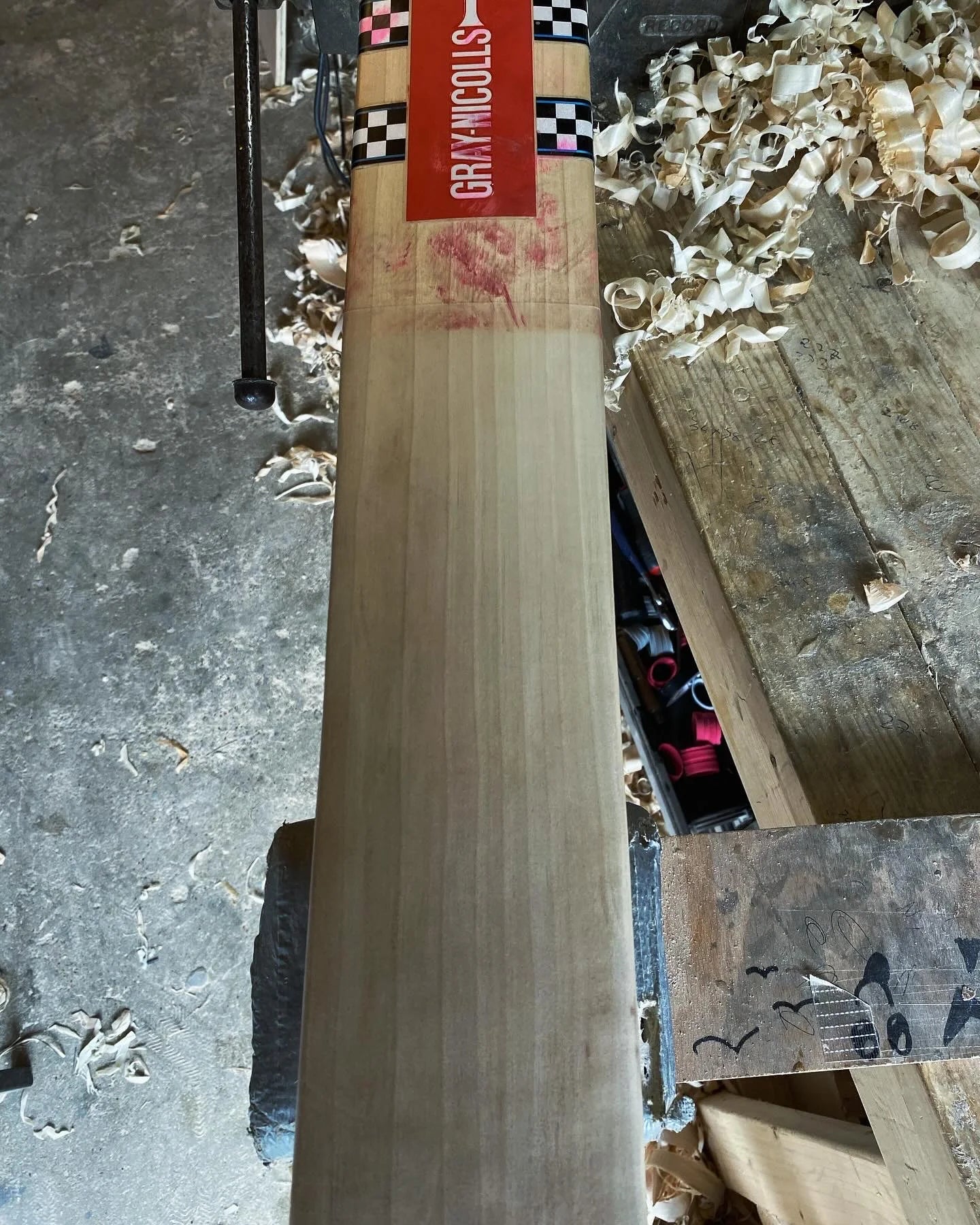
Weighing the cricket bat is vital and happens throughout the shaping process. The image above shows the raw cricket bat at 2lbs 8.6oz. The target dressed weight (with stickers and grip) is 2lbs 10oz. The binding, grip, and stickers add circa 2oz, so there is a little more to take off to get the target weight, which would fit in the medium weight range.
Lightweight (2lbs 4oz to 2lbs 6oz)
Lightweight cricket bats, typically 2.4 to 2.6 pounds, are ideal for players who prioritise speed and precision over brute force. They are also easier to manoeuvre, making them an excellent choice for players who rely on timing and finesse.
They are particularly beneficial for players with a more classic or technical batting style, which emphasises ground strokes and finding gaps in the field.
Lightweight bats allow quick wrist work, making them suitable for playing cut and pull shots or cross-batted shots.
They are also advantageous for younger or less physically strong players who might struggle with a heavier bat.
Medium Weight (2lbs 6oz to 2lbs 9oz)
Medium-weight bats, which fall in the range of 2.6 to 2.9 pounds, offer a balanced blend of power and control. This weight range is often the most popular among adult cricketers as it provides enough heft to play powerful shots while still maintaining good bat speed.
Medium-weight bats are versatile and can adapt to various playing conditions and styles. They are suitable for players who like to mix aggressive stroke play with deft touches.
These bats provide a good balance point, making them easier to handle and offering stability during shots, essential for maintaining accuracy and power.
Heavyweight (2lbs 9oz to 3lbs 1oz)
Heavyweight cricket bats, weighing between 2.9 and 3.1 pounds, are designed for players who prioritise power-hitting. They are ideal for aggressive batters who aim to clear the boundary regularly.
The additional weight provides more mass behind the ball, thus enabling harder hits. However, they require more strength and skill to wield effectively.
Heavyweight bats are generally preferred by well-built players or those who have developed strong upper-body strength.
They are less manoeuvrable but can be incredibly effective in the hands of a player who can control them well. These bats are suitable for players who are confident in their ability to time the ball despite the extra weight.
What Weight of the Cricket Bat is Suitable for Playing?
Adult Cricket Bat Weights
Cricket bat weight for adults typically ranges from 2lbs 4oz to 3lbs 1oz. Adults should choose a weight that complements their strength and playing style, ensuring comfort and efficiency.
Junior and Youth Cricket Bat Weights
For junior players, lighter bats are advisable. These bats allow younger players to develop their skills without straining their arms or compromising their technique.
Weight of the Cricket Bat According to Their Size
Size 1 = 1lb 7oz to 1lb 9oz
Size 1 bats are designed for young beginners, with a typical height of 1.2m to 1.29m.
The lightweight makes it easier for them to learn the basics of batting.
Size 2 = 1lb 9oz to 1lb 11oz
Slightly heavier than size 1, size 2 bats suit children with a typical height of 1.29m and 1.37m.
They provide a good balance between weight and control for developing players.
Size 3 = 1lb 11oz to 1lb 13oz
These bats are for children with a typical height of 1.37m to 1.44m.
The incremental weight increase helps in adjusting to larger bats over time.
Size 4 = 1lb 13oz to 1lb 15oz
Size 4 bats are ideal for players with a typical height of 1.44m to 1.5m, offering a slightly heavier option for growing cricketers.
Size 5 = 1lb 15oz to 2lb 1oz
Size 5 cricket bats are suitable for kids with a typical height of 1.5m and 1.57m The size 5 bats start to bridge the gap between junior and adult sizes.
Size 6 = 2lb 1oz to 2lb 3oz
Size 6 cricket bats are geared towards players with a typical height of 1.57m and 1.63m, preparing them for adult-sized bats with a manageable weight increase.
Harrow = 2lb 3oz to 2lb 5oz
Harrow bats are perfect for teenagers with a typical height of 1.63m and 1.68m, providing a near-adult experience in weight and size.
Small Adult = 2lb 5oz & Above
Small adult bats cater to those who are transitioning to full-size bats but still prefer a lighter weight and are 1.68m to 1.75m tall.
Short Handle = 2lb 6oz & Above
The short-handle bats are a standard choice for adult players, offering a range of weights to suit different styles.
Long Handle / Short Blade = 2lb 6oz & Above
Long handle cricket bat, These bats cater to taller players, providing a longer handle for a comfortable grip.
Long Blade = 2lb 9oz & Above
Long blade bats are suitable for players who prefer a longer bat for extended reach.
Long Handle - 2lb 9oz & Above.
Long-handle bats provide extra leverage, ideal for players with a preference for longer handles.
Long Handle Long Blade = 2lb9oz & Above
These bats combine a long handle and blade, offering a unique option for players seeking both features.
For short handle, long handle/long blade, long blade, long handle and long handle/long blade, the height of the batter does come into it, but the feel and personal preference are more prominent.
The image below shows the universally recognised cricket bat size and weight guide for all bats.

Conclusion
Trogon Cricket excels in crafting handmade cricket bats to suit all shapes, sizes, and weights, ensuring that every batter's requirements are met. With an extensive selection of Grade 1, Grade 2, & Grade 3 English willow clefts, we offer complete customisation to cater to every player's needs.
Whether you're looking for a lightweight bat for quick stroke play or a heavy bat for powerful hitting, Trogon Cricket has you covered, with a price point that suits all budgets.
Playing Our Part in Your Cricket Story
We know that cricket is more than just a game; it’s a passion, a community, and a lifetime of memories. That’s why every Trogon bat is made with care, dedication, and pride. We see our role as more than just bat makers; we’re part of your cricket journey.
From the first knock in the nets to the biggest innings of your career, we want to be there with you.
Choosing Trogon means choosing a bat made with honesty, integrity, and the same love for the game that you carry to the crease.
Trogon Product Guarantee
When you buy from Trogon, you’re covered by our 6-month bat guarantee. If your bat cracks or breaks within that period and has been knocked in correctly, we’ll replace it with a new one, simple, fast, and hassle-free. Combine that with your statutory online protections, and you can shop with total peace of mind.